
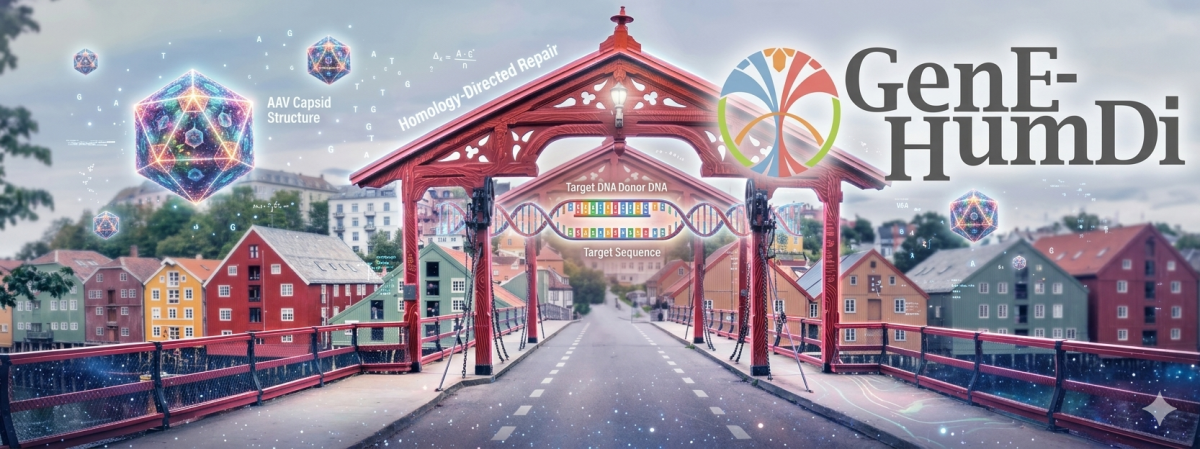
We are thrilled to announce our upcoming Training School on Homology-Directed Repair (HDR) and Adeno-Associated Virus (AAV) Based Delivery Technologies, hosted at the Kavli Institute for Systems Neuroscience in Trondheim, Norway.
June 24th -26th,
write it down now!!
This 3-day intensive course is designed for researchers and professionals looking to master precise DNA repair mechanisms and cutting-edge gene delivery platforms. Participants will explore the theoretical foundations of genomic integrity and gain practical insights into leveraging these pathways for accurate gene editing applications, specially addressed towards therapeutic use.

The training is structured into three thematic days, each led by distinguished experts in the field:
June 24th:
T Cells In Vitro Gene Editing & HDR Strategies
- Focus: Molecular mechanisms of HDR, designing HDR experiments for CAR-T cell therapies, and drug modulation to enhance repair efficiency.
- Confirmed Speakers & Organizers: Karim Benabdellah, Alessia Cavazza, and Erden Atilla.
June 25th:
Hematopoietic Stem Cells (HSCs), In Vivo Gene Editing & Metabolic Diseases
- Focus: HSC biology, HDR strategies for in vivo editing, and clinical approaches for treating metabolic diseases through genomic modification.
- Confirmed Speakers & Organizers: Gloria Gonzalez-Aseguinolaza and Jose-Carlos Segovia
June 26th:
AAV-Based Delivery of Gene-Editing Components
- Focus: AAV production strategies (iodixanol gradient vs. affinity chromatography), cell-type specific delivery, and qPCR-based vector titration.
- Confirmed Speakers & Organizers: Rajeevkumar Raveendran Nair, Dr. Sofie Snipstad, and Petter Anderse

Training overview
This course offers an in-depth overview of Homology-Directed Repair (HDR) and homologous recombination, two fundamental cellular mechanisms for precise DNA repair and genome engineering. The training will take place June 24th to June 26th, and is designed for researchers, students, and professionals interested in understanding how these pathways maintain genomic integrity and how they can be leveraged for accurate gene editing applications. The program will cover the molecular mechanisms underlying HDR and homologous recombination, with a particular focus on their use in CRISPR/Cas-based genome editing strategies. Participants will explore real-world case studies and experimental approaches aimed at achieving precise genetic modifications through HDR. The training school will focus as well on adeno-associated virus (AAV) delivery vectors and their applications in gene editing, together with an overview of current production platforms for research. Key purification approaches, including iodixanol gradient ultracentrifugation and affinity chromatography, will be discussed, with emphasis on the critical steps involved in these techniques. The program will also cover vector titration using quantitative PCR (qPCR) and the interpretation of resulting data.
In addition, the course will address current challenges and limitations associated with HDR-based editing, including efficiency and cell-cycle dependence, as well as emerging strategies to enhance HDR outcomes. Alternative DNA repair pathways, such as Non-Homologous End Joining (NHEJ) and base editing technologies, will also be discussed to provide a comprehensive perspective on genome editing approaches. By the end of the course, participants will have gained both theoretical insights and practical guidance to apply, HDR, homologous recombination, and AAV production techniques, effectively in their own research projects.
Main Objectives
- To provide a comprehensive understanding of the molecular mechanisms underlying Homology-Directed Repair (HDR) and homologous recombination.
- To explain the role of HDR and homologous recombination in maintaining genomic integrity and enabling precise genome editing.
- To explore how HDR pathways can be harnessed for accurate genetic modifications using CRISPR/Cas-based technologies.
- To analyze the limitations and challenges associated with HDR-mediated genome editing and discuss strategies to enhance editing efficiency.
- To compare HDR with alternative DNA repair and genome editing pathways, including Non-Homologous End Joining (NHEJ) and base editing.
- To equip participants with practical knowledge and experimental design skills to apply HDR-based genome editing approaches in their own research projects.
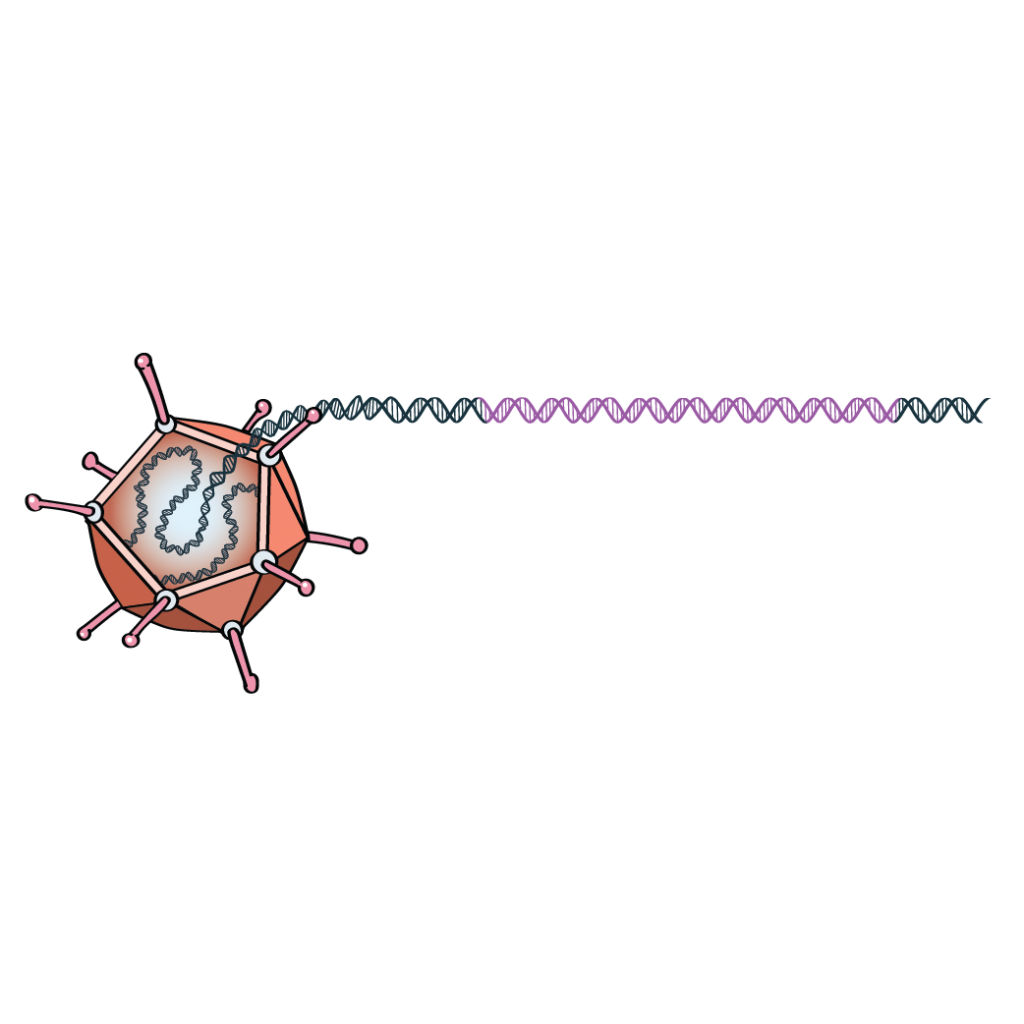
- To understand Adeno-associated virus (AAV) delivery vectors and their applications in gene editing.
- To discuss critical steps involved in iodixanol-based purification compared to chromatography-based methods.
- To demonstrate vector titration using quantitative PCR (qPCR) and interpretation of resulting data.
Expected Outputs
- ● Participants will gain a solid theoretical understanding of Homology-Directed Repair (HDR) and homologous recombination mechanisms.
- ● Participants will be able to design and plan genome editing experiments that utilize HDR pathways for precise genetic modifications.
- ● Participants will acquire practical experience in laboratory techniques for HDR-based genome editing and in the bioinformatics analysis of the recombination outcome
- ● Participants will be able to critically evaluate the limitations and efficiency of HDR in different experimental contexts and propose strategies to overcome them.
- ● Participants will understand and compare alternative DNA repair and genome editing pathways, including NHEJ and base editing, and their applications.
- ● Participants will be equipped to apply HDR and homologous recombination knowledge to their own research projects, enhancing experimental design and outcome predictability.
- ● Participants will acquire knowledge on adeno-associated virus (AAV) delivery vectors and their applications in gene editing, alongside an overview of current research production platforms.
- ● Participants will understand the key purification approaches, including iodixanol gradient ultracentrifugation and affinity chromatography, as well as vector titration by qPCR, with emphasis on critical methodological steps
Application & Funding
GenE-HumDi courses are open to all EU members and Near Neighbour Countries, with a particular focus on promoting the participation of Inclusiveness Target Countries and encouraging Early career scientist.
- Cost: Selected attendees are enrolled free of charge.
- Limited Capacity: Seats are strictly limited to ensure high levels of interaction between trainers and trainees.
- Funding: A call is now open to provide financial support for travel costs and daily allowances for selected participants, in accordance with COST guidelines.
A call is opened to provide funding for selected participants, to cover Travel costs and Daily Allowances, in accordance with the COST guidelines https://www.cost.eu/uploads/2025/11/COST-094-21-Annotated-Rules-for-COST-Actions-Level-C-V3.0-25-IX-2025.pdf
IMPORTANT CONSIDERATIONS
Only applications received before May10th will be considered for Funding.
Applicants need to send the form bellow to raquel.soriano@juntadeandalucía.es
These forms will be used to shortlist applicants in case they exceed the seats available.
Further details on the calendar and contents will be disclosed shortly. Please check regularly our media for updates.